Building a Horizon Scanning function for Defra

Helping Defra build an evidence base for the long-term global shifts shaping future policy and operating contexts.

CLIENT

Defra

YEAR

2024

DELIVERABLE

Global Megatrends Report, Horizon Scanning and Emerging Trends research

The Challenge

Defra wanted to strengthen its evidence base around the long-term forces shaping its future operating environment. This meant looking beyond immediate policy pressures to understand the deeper political, social, environmental, technological and economic shifts that are influencing the world Defra works within.

Client Details

Department for Environment, Food and Rural Affairs (Defra) is a UK Government department, based in England, responsible for policies that affect the natural environment, food production, farming, and rural communities.

Our Approach

The Global Megatrends report sat within a wider programme of work alongside Horizon Scans and Emerging Trends. While those products focussed on weak signals and emerging patterns of change, the Global Megatrends report needed to zoom out: identifying the large-scale structural forces that have shaped global systems over decades, centuries and, in some cases, millennia.

The work began with a comparative analysis of existing global megatrend publications, produced by governments, consultancies and NGOs. From this, we identified a longlist of potential megatrends, reviewed them against Defra’s previous global megatrends work, and carried out further desk research using primary and secondary sources.

A key part of the project was building a tighter definition of what should count as a global megatrend. Rather than treating megatrends as broad themes or forecasts, we defined them as structural forces with global breadth, significant scale, and a clear direction of travel over time.

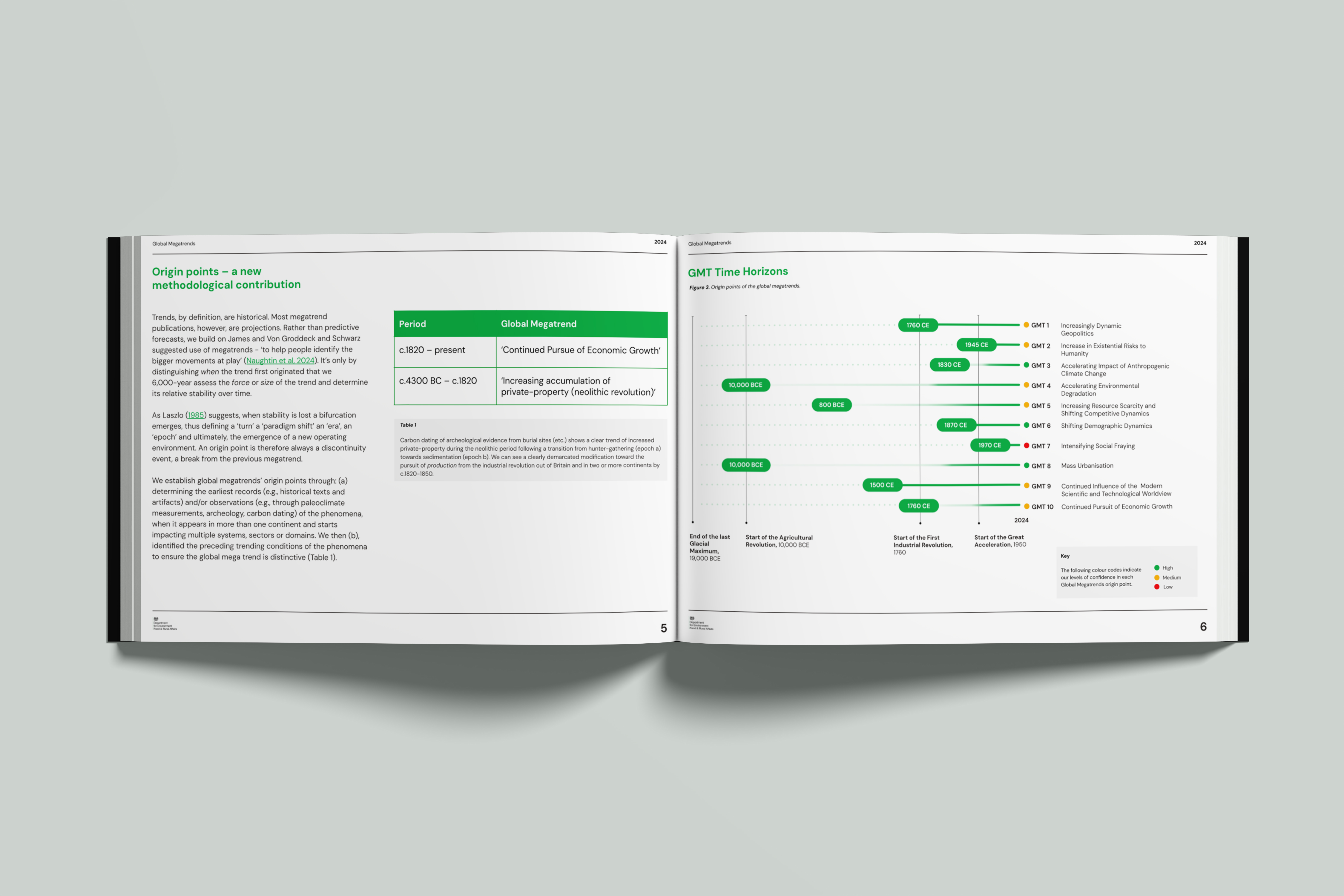
This led to a new methodological focus: origin points. For each megatrend, we looked historically for the moment at which a clear shift from one operating environment to another became visible across multiple continents, sectors or systems. This helped move the report away from prediction and towards understanding the long-run forces already shaping the present.

We then developed 12 draft megatrends and tested them through challenge sessions with 44 international experts from government, academia, industry and NGOs. Through this process, two proposed megatrends were removed because they did not meet the evidence threshold, resulting in a final set of 10 Global Megatrends.

Results

1

A clearer view of long-term change

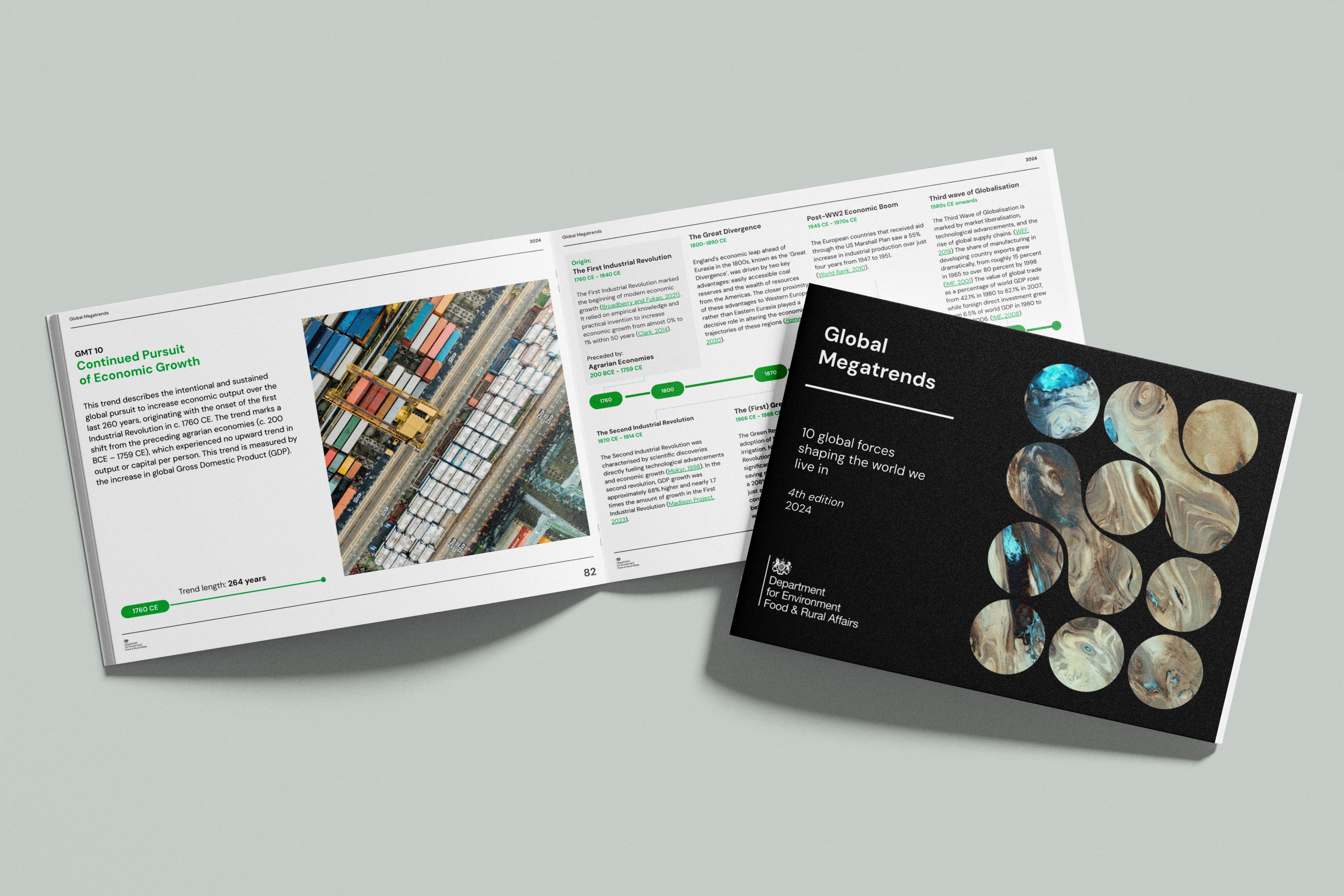
The final report identified 10 Global Megatrends shaping Defra’s future operating environment. Each megatrend included a definition, overview, timeline, origin point, indicators, and advancing or constraining factors, giving Defra a structured way to understand major global forces.

2

A stronger methodology for megatrend analysis

The origin point methodology gave Defra a more rigorous way to distinguish between emerging trends, large-scale structural forces and short-term change. This helped make the report more defensible, historically grounded and useful for strategic discussion.

3

A wider futures system for Defra

The Global Megatrends report was one part of a wider system of futures products, alongside ongoing Horizon Scans and six-monthly Emerging Trends reports. Together, these products helped Defra connect weak signals, emerging patterns and long-term global drivers of change.

A spotlight on origin points

Most megatrend reports look forward. For this project, we also looked back.

We developed an origin point methodology to understand when each global megatrend first became visible as a sustained shift. This helped Defra distinguish between short-term turbulence and deeper structural forces.

For example, the final report mapped megatrends such as Increasingly Dynamic Geopolitics, Accelerating Anthropogenic Climate Change, Accelerating Environmental Degradation, Increasing Resource Scarcity, Shifting Demographic Dynamics and Continued Pursuit of Economic Growth across different time horizons. Some originated in the Industrial Revolution; others were traced back to the Agricultural Revolution or earlier.

This historical lens helped show that many of the forces shaping policy today are not new. They are long-running, interconnected dynamics that require systems thinking, strategic awareness and long-term policy imagination.